
Dynamic and Static Advantages
The oil and vinegar of chess.

There are many types of advantages in chess, but they generally fall into one of two buckets. Dynamic advantages, such as king safety, development, and coordination, demand urgent attention. Static advantages, such pawn structure, space, and material, tend to require patience. In a balanced position, grabbing a dynamic advantage means a static concession and vice versa, and this is the ground over which most chess games are fought. Knowing when a sacrifice is justified, whether or not to move a pawn in front of the king, or if a backwards pawn will hold are all examples of decisions that define one’s skill in navigating the dynamic-static continuum. Along these lines, the stylistic preferences of a player often determine the kinds of positions they aim for: that’s why the archetypal Kasparov win is a dynamic attack on the enemy king, whereas the standard Carlsen victory makes use of a static advantage, often culminating in an endgame grind.
For a variety of reasons — temperament, chess education, experience — I’m a strong believer in power of dynamics. There are a variety of strengths related to this philosophy of chess: I’m quick to notice critical positions, I treat each move with a sense of urgency, and I rarely get flustered by sharp or chaotic situations. These strengths come with weaknesses: a tendency to rush, to alter the position and seek clarity when patience is required. This becomes most problematic when I become bored or frustrated in dry, symmetrical structures. I want positions where it’s possible to talk about one side having the initiative, and I want to be the one that has it!
My most recent game at the Tuesday Night Marathon is a good example of dynamic and static advantages in opposition. I was out of my comfort zone, trying to consolidate a long-term edge, and although I played reasonably well for a time, my opponent played better, keeping up just enough dynamic pressure that I blundered and lost. Here’s the game:
Andy Lee (2322) — Quincy Chen (2077), Silman Tuesday Night Marathon, Round 5
1 e4 c5 2 Nf3 e6 3 d4 cxd4 4 Nxd4 Nf6 5 Nc3 Nc6 6 Ndb5 Bb4 7 a3 Bxc3+ 8 Nxc3 d5 9 exd5 exd5 10 Bd3 00 11 00 Bg4:
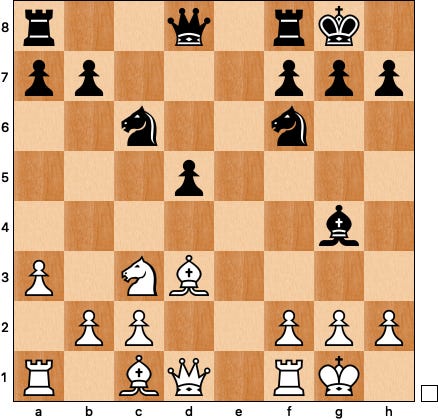
This is a reasonably well known opening position that at first glance looks entirely promising for white, who has the bishop pair and better pawn structure. Twenty years ago I’m sure I would have said that white has a significant advantage, but by now I’ve seen enough grandmaster games in this variation to know better. White’s advantages are static and must be realized through patient, careful consolidation — not exactly my forte. Black has a corresponding set of dynamic advantages that are a little hard to describe given that there’s not much in the white position to attack. I might say that black has great potential to annoy, as demonstrated by his last move, attacking the white queen. The normal move is 12 f3, which slightly opens the white king, leading to further annoyances: 12 … Bh5 13 Bg5 Qb6+ 14 Kh1 Ne4:
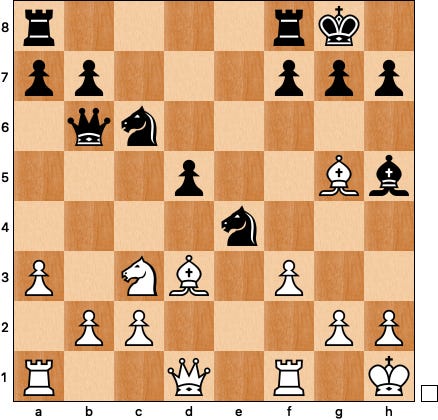
This is a nice example of dynamic defense in action, as black makes use of the pin and the weak b-pawn to exchange some pieces and get closer to a drawn endgame.
I decided to play differently, 12 Qd2!?, an awkward move that avoids weaknesses while trying to make use of the dark squares to stabilize the position. I anticipated the next few moves: 12 … Re8 13 Qf4 Bh5 14 Qh4:
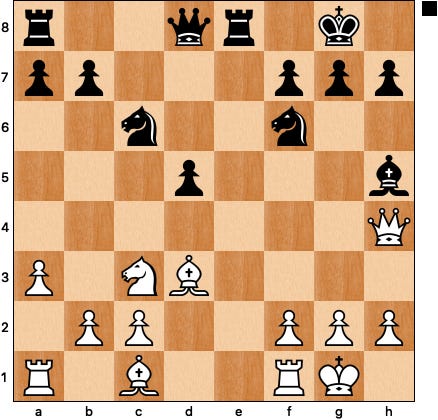
Black’s Nf6 is doing a lot of work holding down h5 and d5, and white is planning to remove it with Bg5. In view of this threat 14 … Bg6 is understandable, but the dynamic potential in black’s position (development, initiative), could have been realized by 14 … d4! 15 Ne4 Bg6, since 16 Nxf6+ Qxf6 17 Qxf6 gxf6 begins the exchange of all of white’s active pieces. Black’s structure is still worse, but white’s pawns are easier to attack: Re8-e2 is coming after the inevitable bishop trade.
The endgame after 15 Bg5 Bxd3 16 Bxf6 Qxf6 17 Qxf6 gxf6 18 cxd3 Rad8 is a tiny bit better for white, but it’s hard to attack black’s weakened kingside, so I played 15 Bxg6 hxg6 16 Bg5 d4 17 Rad1 instead:
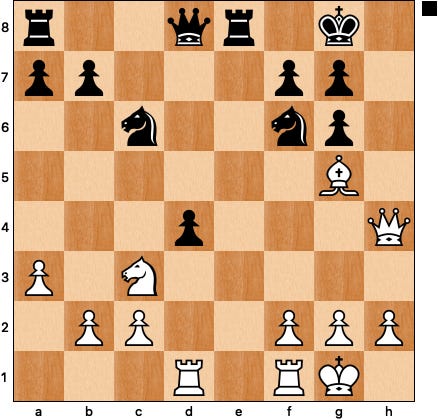
I was optimistic about my chances. It’s not easy to get out of the pin, but if black does nothing Rd1-d3-h3 wins easily. 17 … Re5 looked like a creative way to cover black’s fourth rank, so I spent some time calculating lines like 18 Rd3 Qd6 19 Bf4 Rh5 20 Bxd6 Rxh4, but my opponent found a simpler solution, 17 … Qd6. In my previous calculations I’d assumed this was problematic because of 18 Bxf6 Qxf6 19 Qxf6 gxf6 20 Nd5, threatening forks on c7 and f6. But black is fine here thanks to 20 … Re2 — white hasn’t managed to contain black’s dynamic counterplay.
I switched to idea #2, 18 Nb5, but my opponent reacted precisely: 18 … Qc5! 19 Bxf6 (19 Nc7 fails to accomplish anything thanks to 19 … Re4) 19 … Qxb5 (to stop 20 Nc7) 20 Bxd4:
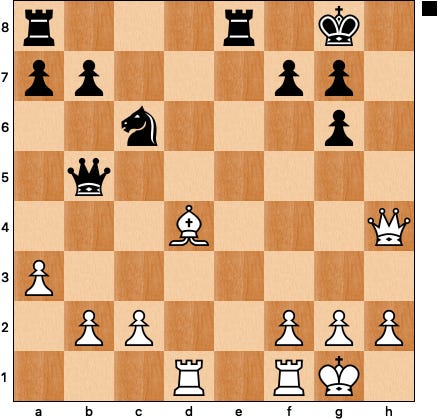
White’s static advantage has been transformed from two bishops and better structure to an extra pawn, but black’s activity continues to be a problem. The weakness of the c-pawn suggests a variety of candidate moves, from 20 … Rad8 to 20 … Nxd4 21 Qxd4 Re2 to the move played in the game, 20 … Re2. It’s an interesting exercise to figure out which of the three is the most reliable way to equalize, but in any event, the game continued with 21 Bc3!, a strong move that relinquishes the extra pawn (which couldn’t be saved anyway) for another static advantage, that of the bishop over the knight.
I was hoping to seem something like 21 … Rxc2 22 Rfe1 Re2 23 Rxe2 Qxe2 24 Re1 Qd3 25 Qe4 Qxe4 26 Rxe4:
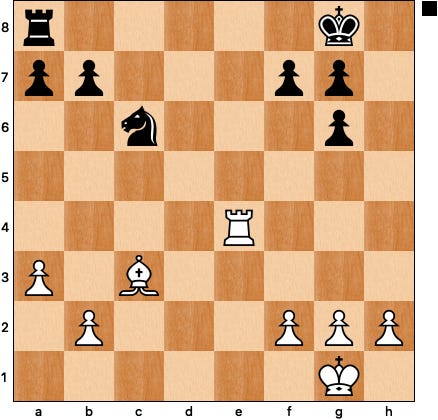
The engine does not think that there’s anything here, but white is clearly the one pressing, and can do so for a long time with almost no risk of losing. The bishop is better than the knight and as long as the rooks remain on the board white should always have winning chances. Most importantly, white’s static advantages have outlasted black’s dynamic activity, which is disheartening for the second player, who is now just playing defense. I can remember losing more than one game like this against stronger opponents in my youth.
My opponent did not oblige, and instead played another move to increase his activity, 21 … Rae8:
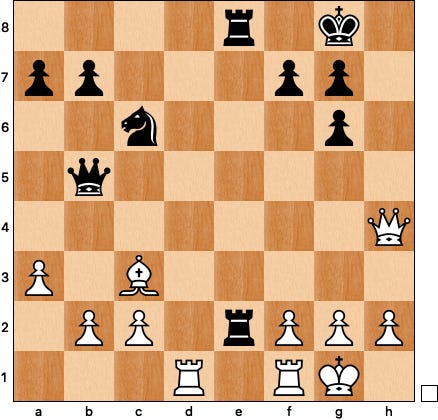
Neither side shows much interest in the c-pawn; the battle for activity is more important for the moment. If white shifts to a greedy approach the game could end in a draw that shows the balance between dynamic and static strategies: 22 Rc1?! Qf5 23 Qa4 R8e4 24 Qb3 Rg4 (24 … b5 is worth a look if black wants to fight on) 25 Qxb7 Rxg2+! with a perpetual.
Another important variation begins 22 Rd3, aiming for the h-file. The problem is 22 … Rxc2 23 Rh3?? Qxf1+! 24 Kxf1 Rc1+ with mate to follow. It turns out that the black queen is very well placed on b5. With this in mind I played 22 Qf4, improving the queen and keeping a defensive eye on c1. Black played 22 … Rxc2 and now there’s another important decision to make:
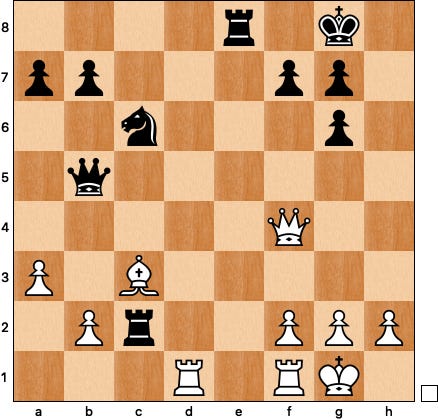
In the struggle between dynamic and static advantages, a single tempo is often enough to swing the game between a successful attack and the evaporation of the initiative. In this case the capture on c2 has left black slightly disorganized. From white’s perspective making luft on the back rank with something like 23 h3 is very natural, but it gives black enough time to play 23 … Rce2 24 Rd7 R2e7, defending harmoniously.
I played 23 Rd7 instead, which is objectively the right decision — with the queen covering c1, the Qxf1+ trick doesn’t work. Black doesn’t have a great way to cover f7. He doesn’t want to play 23 … Rf8 for obvious reasons, 23 … Qf5 drops the b-pawn, and 23 … Qb3 is met by 24 Qc7. He played the most obvious move, 23 … Ne5, but after 24 Rc7 the threat of Bxe5 is annoying:
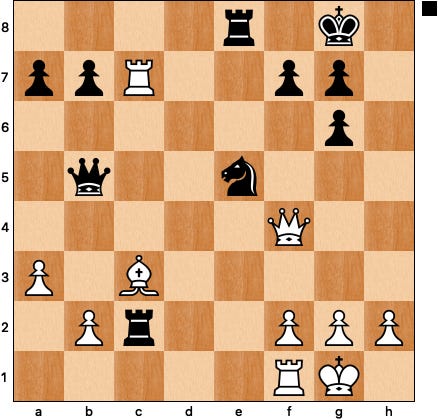
The key to playing good dynamic chess is to never stop threatening tactical tricks: you’re not playing a computer, and people make all kinds of mistakes as they try to snuff out the initiative. In this position black played the clever 24 … g5, a move I’d rejected as foolish — it seems that I can just improve my queen with the same threats as before.
At play here is my ever-present desire to swap static advantages for dynamic ones; that is, to maximize the aggressive potential of every move. I jumped at the chance to play 25 Qf5??, hitting the Rc2 and maintaining pressure on f7, and, you guessed it, falling right into the Qxf1+ tactic that I was all too aware of. It doesn’t work immediately, but 25 … Nf3+! and the tactic is back on; there was nothing to do but shake my head and resign.
I thought that this was an interesting game until I blundered, but the blunder itself is evidence of why it’s hard to fight against a dynamic approach, and why I prefer to have the initiative as often as possible. I want to be the one coaxing my opponents into blunders, not the other way around.
There are disadvantages to playing middle-aged chess, including lack of sleep and the distractions and responsibilities of adult life — I mean, I left my wallet at home when I went grocery shopping a day or two after playing this game, which a fairly equivalent real life blunder to the move Qf5 — but also advantages, such as the fact that I can shake off a loss like this more easily than I could in my youth. I don’t enjoy falling into mate in four and getting upset, but I’ve lost so many games of chess for all kinds of stupid reasons that one more isn’t going to hurt me. At the very least it’s nice to keep playing, even if I’m only occasionally able to hit the level I reached a decade ago.
"One of us! One of us!"
Fun read. Like you, my most recent post is about a loss that I perhaps would not have suffered in my “prime.” I’m inspired and will thus jump back into the fray.