
Fact and/or Fiction
Exploring the boundaries of the novel.

In History: A Very Short Introduction, John Arnold makes the argument that the study of history and literature are linked by the importance of narrative in each discipline:
Historians tell stories, in the sense that they are out to persuade you (and themselves) of something. Their methods of persuasion depend in part upon the ‘truth’ - not making things up, not presenting matters as other than they are - but also in creating an interesting, coherent and useful narrative about the past. The past itself is not a narrative. In its entirety, it is as chaotic, uncoordinated, and complex as life. History is about making sense of that mess, finding or creating patterns and meanings and stories from the maelstrom.
A literary narrative is not exactly an argument, but it’s similar in that tries to make sense out of the chaos that is the human experience. I’ve read a lot of historical fiction over the past few years, and I never fail to be amazed by how beautifully authors like Hilary Mantel and Álvaro Enrigue write novels that make sense of the past while providing meaning in the present. There is value to being put into the mind of Thomas Cromwell or Moctezuma or Robespierre even if what we find there is something imagined, the product of the mind of the author, informed by their own reading of history.
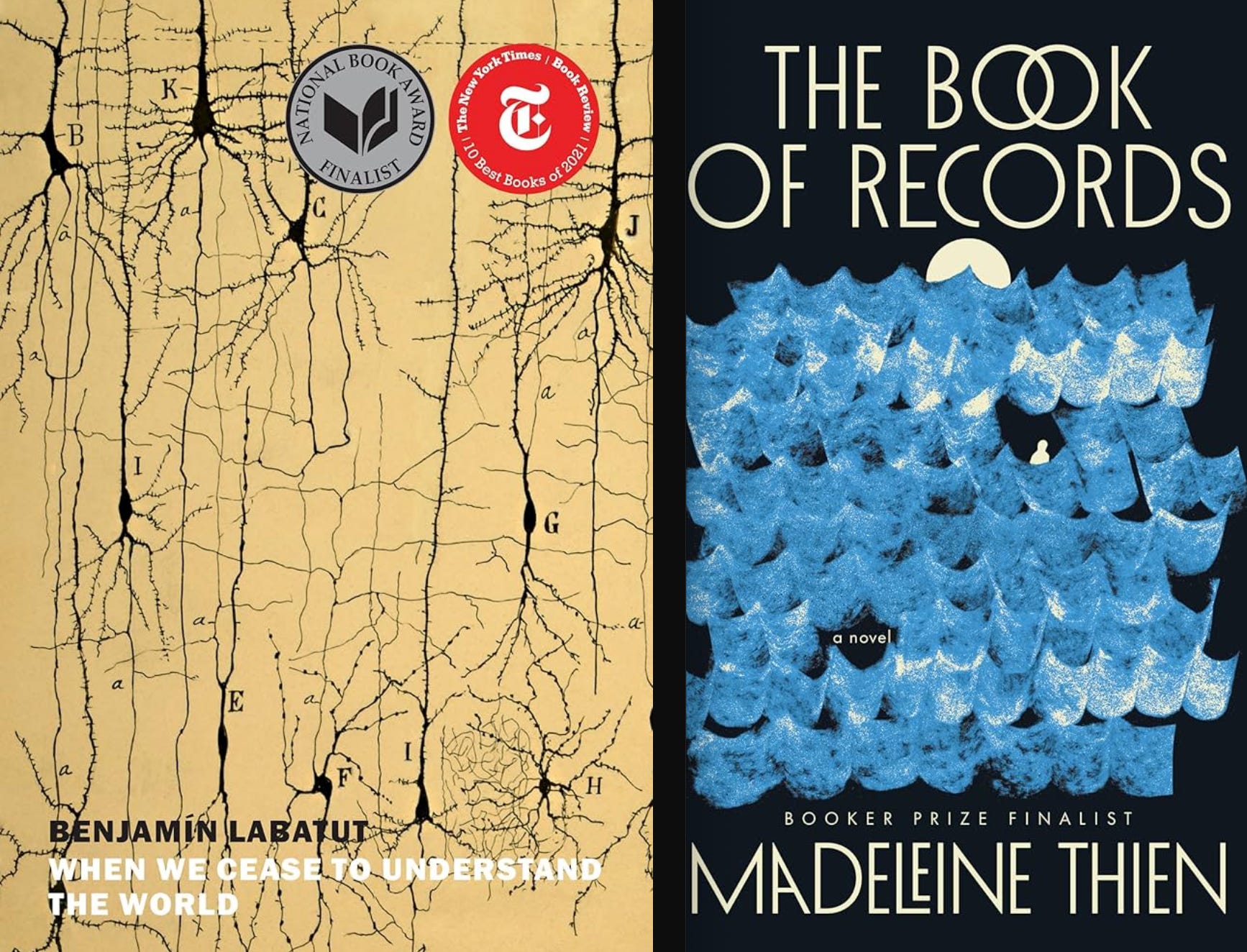
On a more general level, all pursuits of knowledge, from physics to poetry, require imaginative leaps of faith. This is the premise of Benjamin Labatut’s strange novel1 When We Cease to Understand the World, which places the reader in the shoes of some of the most influential scientists and mathematicians of the twentieth century: Fritz Haber, Karl Schwarzschild, Alexander Grothendieck, Erwin Schrödinger, and Werner Heisenberg. These men eat and lust and grow ill, but mostly they figure things out and argue about their findings and become concerned that they may have penetrated too deeply into the secrets of the universe. The cat may be Schrödinger’s, but the box is Pandora’s.
It’s an interesting premise for a novel, perhaps the start of a nameless new genre, since we can’t call it “historical science fiction” without calling to mind old sci-fi masters like H. G. Wells and “scientific historical fiction” doesn’t roll off the tongue. In fact, When We Cease to Understand the World begins with very little fiction at all, preferring instead to present of a constellation of facts. From the opening chapter:
Haber had converted to Christianity at twenty-five years old. He identified so closely with his country and its customs that his sons knew nothing of their ancestry until he told them they would have to flee Germany. Haber escaped after them and sought asylum in England, but his British colleagues scorned him, aware of his instrumental role in chemical warfare. He had to leave the island not long after arriving. Thenceforth, he would travel from country to country in the hope of reaching Palestine, his chest gripped with pain, his arteries incapable of delivering sufficient blood to his heart. He died in Basel in 1934, clutching the canister of nitroglycerine he needed to dilate his coronary vessels, not knowing that, years later, the Nazis would use in their gas chambers the pesticide he had helped create to murder his half-sister, his brother-in-law, his nephews and countless other Jews who died hunkered down, muscles cramping, skin covered with red and green spots, bleeding from their ears, spitting foam from their mouths, the young ones crushing the children and the elderly as they attempted to scale the heap of naked bodies and breathe a few more minutes, a few more seconds, because Zyklon B tended to pool on the floor after being dropped through the hatches in the roof. When ventilators had diffused the cloud of cyanide, the bodies were dragged to enormous ovens and incinerated. The ashes were buried in pit graves, dumped in rivers and ponds, or scattered as fertilizer in the surrounding fields.
By some measures, Haber is the most important scientist of the twentieth century. Einstein’s theory of general relativity may have revolutionized physics, but Haber’s development of synthetic fertilizers was a necessary precursor to the Green Revolution; without it there’s famine, not eight billion people on the planet. But Haber’s brilliant feats of chemistry were also used in some of the most notorious war crimes of the twentieth century, a terrible history that Labatut artfully weaves together in the passage above.
Can the careful sequencing of historical facts be a novel? On the one hand, no, that flies in the face of the definition of the novel itself. On the other hand — well, let’s put it like this: in the kitchen I might mix together flour, butter, eggs, and sugar, and a cake is born; but with a different ratio of ingredients or different order of operations I’ll get something very different, a final product that only slightly resembles food. There is nothing inevitable about a cake, even if I have the right ingredients on hand, and in the same way it’s possible to imagine all kinds of accounts of Haber’s life that fail to reach the standard of literature.
Take another look at the very literary passage above, and notice how Labatut moves from moment to moment. He begins by showing us a disgraced Haber, ostracized by his fellows, exiled in both life and death. Rather than rehabilitate the chemist’s image, he hits us with the terrible irony that Haber’s work was used in the Nazi death camps. Haber was spared this knowledge, but we are shown that once humanity discovers a tool it is nearly impossible to stop using that tool, even if its only purpose is the murder of innocent souls. The passage lingers on these deaths, unbearably so, as if to demonstrate, QED, that modern science is a deadly thing, pilling up a body count by the millions, bodies burned and “scattered as fertilizer in the surrounding fields.”
And so we end with an image of fertilizer, Haber’s great contribution to the progress of humanity, not as a triumph but as a funereal grace note. Only fiction, in my opinion, has the power to expose paradoxes like this one so neatly.
The stories in When We Cease to Understand the World become more clearly identifiable as historical fiction as the book progresses, but they remain fixated on the problem of scientific discovery. There are many epiphanies here, generally magical in nature, a kind of waving of the hands and leaning heavily on the concept of “the genius.”2 Here’s one example:
Heisenberg woke in the middle of the night. His fever had broken and his mind was exceptionally clear. He stood up from the bed and dressed mechanically, feeling himself totally alienated from this body. He approached his desk, opened his notebook and saw that he had finished every one of his matrices, even though he did not know how he had constructed half of them. He took his coat and walked out into the cold.
I have a better understanding of how the magic works in Harry Potter, but of course that’s the problem of quantum physics in a nutshell: it only makes sense to a very limited number of people in the world.3 The title of Labatut’s novel — When We Cease to Understand the World — addresses this paradox. Science is supposed to work in the service of understanding the world in which we live, but some avenues of scientific inquiry have made the world less comprehensible to the layman. At a sub-atomic level everything might be a bunch of vibrating strings, but that has little to do with how you or I or anyone else experiences the reality of being alive.
It’s an interesting problem set by the novel, to let the reader grapple with the fact that the invented aspects of the characters’ lives feel true whereas their scientific discoveries defy common sense. It was too much even for Einstein, who, confronted with the paradoxes inherent in quantum physics, famously said, “God does not play dice with the universe.”
The Book of Records, by Madeleine Thien, is more obviously a novel, but it soon wanders across the porous boundary that separates fiction and fact. Two refugees, a girl named Lina and her father, arrive at a liminal place, a surrealist structure4 called the Sea. They bring only three books, each one from a set of biographies called The Great Lives of Voyagers. The three cover the lives of the Tang Dynasty poet Du Fu, the philosopher Baruch Spinoza, and the political theorist Hannah Arendt. The metaphysics of the Sea being Borgesian at best, all three happen to be living next to Lina. Generally one leaves the Sea within a few days, but Lina’s father is too sick to travel, and so she has plenty of time to listen to each of the three tell the “true” story of their lives.
There is a little more to the frame story — Lina’s father eventually reveals his past — but Thien often seems more interested in philosophy than she is in creating dramatic tension. Du Fu, Spinoza, and Arendt are great voyagers of the mind, and even the telling of Arendt’s escape from Nazi-occupied France is flooded with all kinds of philosophical inquiry. I found myself trying to determine a central question or theme that links all four of the narratives, briefly landed on the nature of freedom, and then gave up. There’s just too much going on here, too many links and parallels, and if there’s one field I understand less about than physics, it’s philosophy.
The Book of Records is beautifully written, but I struggled with the same set of problems that I had when reading When We Cease to Understand the World. Is a book a novel even if it subverts many of the attributes that define the form? And novel or not, what exactly is the reader supposed to get from a book that, while concocted from a mixture of flour, butter, eggs, and sugar, tastes nothing like a cake?
Thien anticipates this question and answers it through the voice of one of her characters:
“The brief flare of imagination,” Wolkowski was explaining, “arises when images of one’s own time are struck like a match against the time of an earlier era. We are the match and they are the ground. One day we will be the ground, and the future will strike its match against us.”
This is a wonderful image, the perfect rationale for historical fiction everywhere and both Labatut’s and Thien’s novels specifically. Each is a novel of ideas, and the ideas within flare up and gain shape as one sees them reflected in the present. Both novels demand a slow, careful reading, and I wouldn’t recommend either one if you’re looking for resolution, but it is sometimes nice to just sit and think about the world, with just enough narrative power to make the whole thing go.
Should we call it a novel? Sure, why not.
“The Genius” is a great Donald Barthelme story, by-the-by.
For example: I was intrigued by the chapter about the mathematician Alexander Grothendieck, looked up some of his work online, and didn’t understand a bit of it. So I emailed a friend with a PhD in math and asked him about Grothendieck, and he sent me a bunch of somewhat frightening looking pdf files which I haven’t dared to open yet.
I couldn’t visualize the Sea as anything other than an M.C. Escher drawing, particularly after this description of it: “One afternoon, we explored a staircase that seemed to branch into itself. I had the sensation that if I turned around, I would be behind or even above us, as if I was falling at different speeds.”
Re: philosophy, here's a quote I came across in Flaubert's letters: "As a rule the philosopher is a kind of mongrel being, a cross between scientist and poet, envious of both. Metaphysics puts a lot of rancor into the blood -- a very curious and very interesting phenomenon. I was considerably engrossed by it for a couple of years, but it was a waste of time I now regret."