
John Willliams' Augustus
The empire strikes back.

I came to love historical fiction as an adult. There were a variety of causes: I’ve taught high school world history for the past dozen years, I’ve gradually become less interested in the genre fiction I devoured in my youth (fantasy, sci-fi), and I stumbled across Hilary Mantel’s novel Wolf Hall, perhaps the greatest piece of historical fiction written this century. This is high praise — The Known World, A Brief History of Seven Killings, and You Dreamed of Empires are some other incredible works of historical fiction all published since 2000.
It should come as no surprise that the recent boom in literary historical fiction coincides with new ways of thinking about world history, beholden no longer to the narrative of the inevitability of western civilization. As historical interpretations grow more nuanced and complex, so do the narratives constructed by authors of fiction — as far as I’m concerned, this is a wonderful symbiosis.
The students in my classes are quick to refer to the old saying that the purpose of learning about history is to avoid repeating mistakes of the past. In the essay “Historian as Citizen,” Howard Zinn provides a more nuanced version of this idea, linking history to literature in the process:
Both history and art should instruct us. The crucial thing is to reveal the relationship between evil and ourselves. This makes it enormously useful to show how Hitler could emerge out of a boy playing in the field. Or to show (as in Lord of the Flies) how innocent children can become monsters, or (as in Bergman’s film The Virgin Spring) how a loving father can become a vengeful murderer or (as in Who’s Afraid of Virginia Woolf?) how an “ordinary” man and wife can become vultures.
But to survey the atrocities in world history and to conclude (as the defense lawyer did in the film Judgment at Nuremberg) that “we are all guilty” leads us nowhere when it neglects to identify the elements of failure so that we can recognize them in the future. On the other hand, to end by punishing the specific persons who were indeed guilty is to leave us all free to act, unnoticed, in the same way. For when our day of judgment comes, it will be, like all the others, one disaster late.
I do not usually approach reading historical fiction with this lens in mind, but sometimes a novel about the past speaks so prophetically about the present that holding it up as a mirror is unavoidable. This was my experience of reading John Williams’ 1972 novel Augustus — not as a vision of the Nixon years, but as a reflection of 2026.
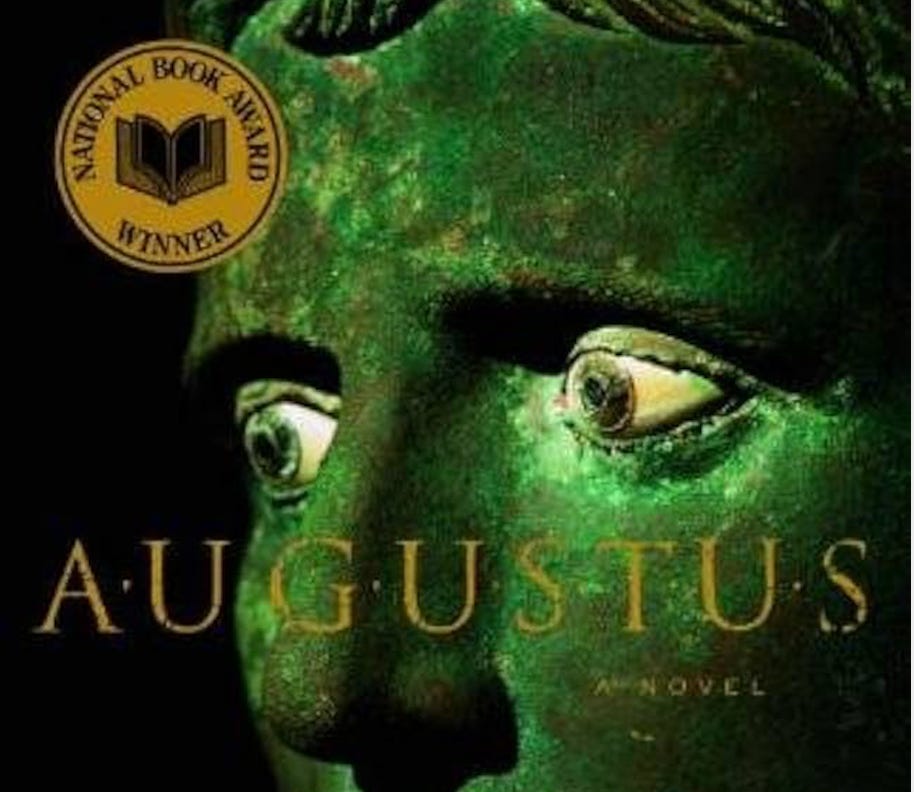
This is as good a time as any to confess that I do not really care about the Roman Empire. The world history course I teach opens in the year 1200 CE and is focused on the dynamic interplay of peoples and cultures rather than trying to fit all of history into the lineage of classical Greece and Rome. I don’t know much about Roman philosophy, Julius Caesar, or what a consul is, and while I know that Pliny the Elder is a delicious beer, I couldn’t tell you much about the man himself.
Augustus is an epistolary novel, a mosaic of letters and memoirs from Romans so famous that even I recognized many of the names: Cicero, Horace, Virgil, Mark Antony, etc. These voices take the stage during the transition from Roman Republic to Roman Empire, the consolidation of power by Octavius, and finally his struggles to pass his empire on to a suitable heir. The novel tends towards the grandiose — I don’t mean this in a pejorative way, but rather as a way of indicating that the characters are aware of their own power and importance:
Do they know that before us lies a road at the end of which is either death or greatness? The two words go around in my head, around and around, until it seems they are the same.
The characters are also aware that the world in which they live is at a tipping point, although few agree on the proper way forward. Some, like Cicero, still believe in the idea of the Republic and despair at its ruin:
I had hoped that the assassination would at once restore our freedom, return us to the glory of our past, and rid us of the upstarts that now presume to disturb the order that we both love. But the Republic is not repaired; those who should act with fortitude seem incapable of resolution, and Antonius prowls like a beast from one spoil to another, pillaging the treasury and gathering power wherever he can.
Others, like Octavius, see only its failings:
Though I probably could not have articulated it then, I knew that my destiny was simply this: to change the world. Julius Caesar had come to power in a world that was corrupt beyond your understanding. No more than six families ruled the world; towns, regions, and provinces under Roman authority were the currencies of bribery and reward; in the name of the Republic and in the guise of tradition, murder and civil war and merciless repression were the means toward the accepted ends of power, wealth, and glory.
These two passages, the product of a historical crisis that took place over two millennia ago, are instantly recognizable as the problems of the present. Anyone who thought that the problems of American politics would be magically repaired when Trump reluctantly left office in 2021 was quickly disillusioned in the years that followed. Similarly, it’s hard to miss the corruption of American life these days to the “ends of power, wealth, and glory.” Six families ruled Rome; a short list of billionaires has incredible influence over both America and the rest of the world.
Augustus provides a temporary solution to the problem of the collapse of the Roman Republic, one that is not particularly palatable to modern folks used to the rights conferred by democratic governments. The novel puts the reader on the side of Octavius and his imperial project by giving voice to characters who sympathize with him and by emphasizing his keen sense of duty. In this way Augustus mirrors the themes of Williams’ earlier novel Stoner, in which a college professor sacrifices his career prospects and a romantic relationship out of a sense that he must do the right thing. In Stoner this is the story of individual struggle, but in Augustus striving to do one’s duty is a utopian dream, the realization of a benevolent dictator who chooses his people before himself and whose desire for power is born out of his need to do service rather than a sense of entitlement or greed. Here is his friend Maecenas, relating Octavius’ request that his sister marry Mark Antony in order to hold the empire together:
I was with Octavius when he explained the necessity to his sister—of whom he was very fond, as you know. He could not look her in the eye when he spoke. But Octavia merely smiled at him and said: '“If it must be done, my brother, it must be done; I shall try to be a good wife to Antonius and remain a good sister to you.”
“It is for Rome,” Octavius said.
“It is for us all,” his sister said.
If only it were so simple. Unchecked power invariably corrupts, and the historical record clearly shows that even if a small handful of monarchs and emperors can be considered good (Octavius among them, according to the novel), most of the time you get repression and greed and famine. One of the ironies of Augustus is that you already know what Octavius suspects: that the emperors who follow him will not be up to the task. Nero is waiting in the wings, and Rome is going to have to burn.
Towards the end of the novel, Octavius considers the possibility that his life’s work has been in vain:
In recent years the possibility has occurred to me that the proper condition of man, which is to say that condition in which he is most admirable, may not be that prosperity, peace, and harmony which I labored to give to Rome.
He goes on to say that the people seem dissatisfied, that they long for the past, and that during times of conflict and hardship they were at their most loyal and strong. Thus Williams subverts the solution embodied by Octavius and his dreams for the Roman Empire. The people, maddeningly, want some greater purpose than he has given them. The greatest impediment to his conception of utopia is human nature itself.
Ultimately, Augustus is the kind of novel that is more interesting to think about than to read. Perhaps part of the issue is that when I read I’d more often than not prefer an escape from the problems that plague modern politics. Perhaps I wished I was reading I, Claudius, a much funnier fictionalization of the Roman Empire. Perhaps binge-watching a bunch of Star Wars caused me to have trouble finding sympathy with the ruler of an imperial system, no matter how dutiful he was to his people. There may not be stormtroopers in Octavius’ Rome, but you know that they’re just around the corner.
I read Augustus a couple years ago and felt similarly -- "more interesting to think about than to read". And I actually care about Roman history! Maybe I should try "I, Claudius" (the BBC version was campy fun). In general, the historical fiction I've read strikes me like an animatronic display at a theme park: a spark of recognition as the mechanical facsimiles trot by, then disgust when their jaws move and prerecorded messages come out. That's how I felt, anyway, when I bounced hard off of Mantel's "A Place of Greater Safety" a while back. The only historical fiction that I truly love (and I don't know if it counts) is Sigrid Undset's "Kristen Lavransdatter". No uncanny valley there -- those characters are as real to me as if they lived yesterday.