
Sindarellov Story
Will the clock strike midnight, or are we witnessing the rise of the next world champ?

I’ve always believed in Javokhir Sindarov. Show you the receipts? Oh, I’ve got ‘em, but there are too many to choose from. How about November’s piece in which I picked Sindarov to win the World Cup:
It might seem strange to pick the 16th seeded Sindarov as the favorite to win the World Cup, but I think he’s got an excellent case. . . . While it’s true that Sindarov is on the easier side of the bracket and won’t have to deal with Erigaisi or Wei Yi until the finals (assuming either one of them makes it that far), he’s actually had a better year than either of his better known rivals, eighth in the world by adjusted performance rating after the conclusion of the Grand Swiss.
Or from last month’s Candidates preview article:
The only difference [in comparison with Pragg] is that Sindarov has been playing great chess recently. His recent performances, including his impressive World Cup victory, are right up there with Giri’s and Caruana’s. He’s moved up almost 20 spots in the world rankings in the past year, and given his age and obvious talent it feels like his current ranking is legit.
And finally the poll at the end of the article:
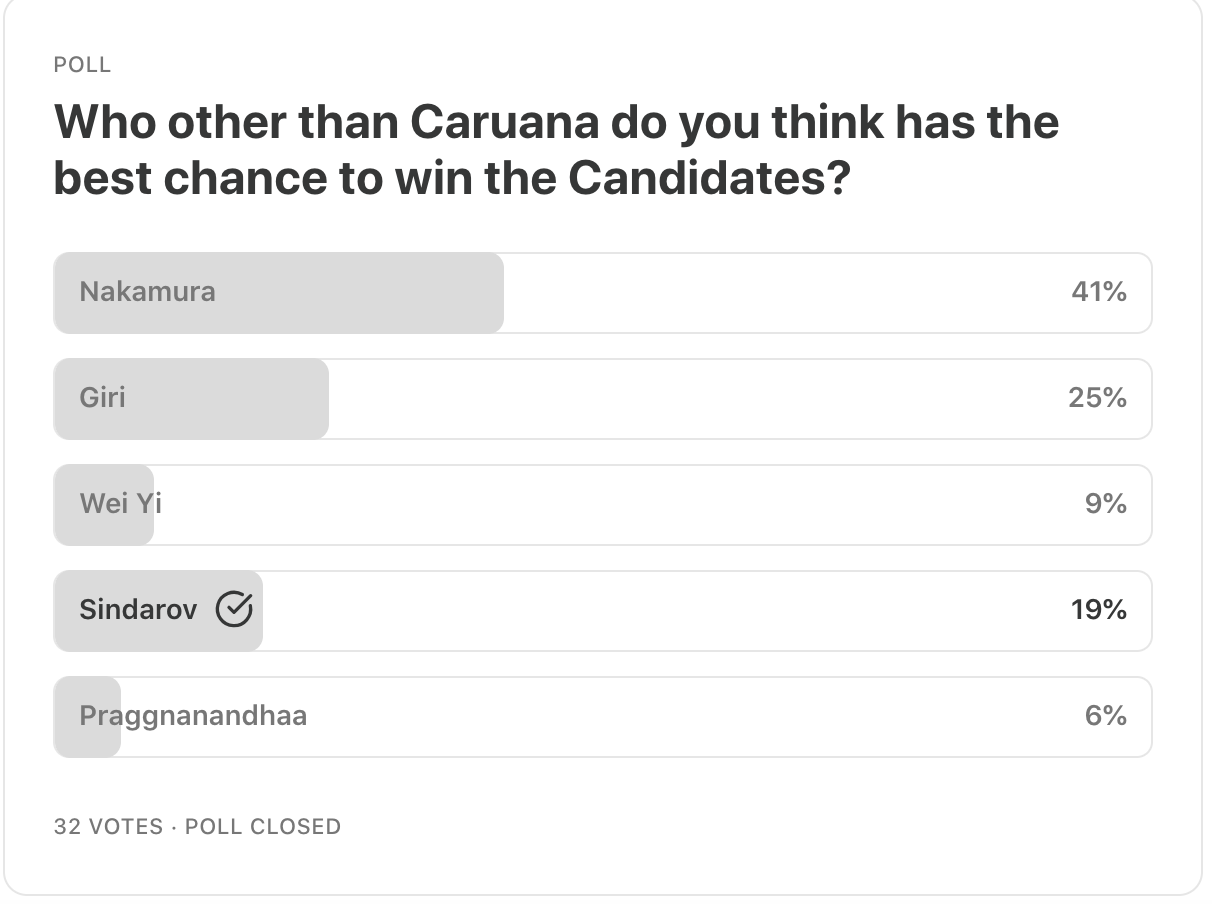
The kid has been on a roll, so much so that the Cinderella moniker doesn’t fit anymore — he’s up to fifth in the world, putting together a performance rivaling 2014 Caruana, 2005 Topalov, and 1971 Fischer. And while I’m happy to claim a spot among the pundits who knew that Sindarov was the best of the players not named Fabiano Caruana, nobody predicted that he was going to score +5 in the first half of the event, a full point and a half ahead of the American.
How is he doing it? The operative concept is flow, what the kids call being “locked in”, a state of sustained clarity and confidence that produces transcendent results. The error free play, the huge advantages on the clock, the sheer inevitability of it all — that’s flow in action, and it’s an incredible thing to behold.
But actually, nothing about what’s happening was inevitable. Consider Sindarov’s first game, when he looked to be on the ropes against Andrey Esipenko:
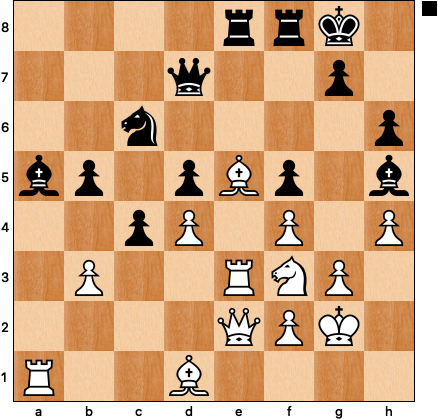
White had been fighting the negative trend for a while (notice how tangled he is on the light squares), and dropping to under ten minutes (to Esipenko’s twenty-two) showed his dissatisfaction with his position. The rule for the stronger side in these situations is to avoid releasing the tension without very good reason, but Esipenko miscalcuated and played 27 … Bxf3+, the first sign that he was not in good form. Sindarov took full advantage, winning with a tactical flourish just after time control.
In round two Sindarov got nowhere against Blübaum, and there was no reason yet to pick him as the favorite to win it all. He was at plus one but had already played his white games against the lowest rated players in the event, with a very challenging set of games ahead: black versus Pragg, white against Caruana, and then two blacks in a row against Naka and Wei Yi.
Then came the second turning point, an error while Pragg was trying to stabilize his delicate position after Sindarov’s piece sac:
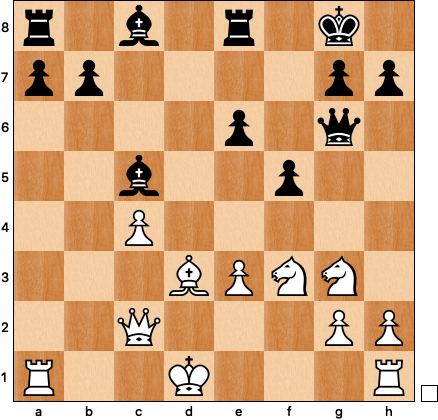
These kinds of non-standard positions put even the best players in the world to the test — it’s not the same as finding the right move in an IQP or Carlsbad structure that has been played thousands of times before. Praggnanandhaa tried to clamp down on e5, but there was a tactical flaw: 19 Qc3 doesn’t actually prevent 19 … e5 due to 20 Nxe5 Qf6, picking up the pinned knight. After 20 Bc2 e4 21 Nd2 the initiative had passed to black, and although there were further mistakes along the way, it’s not surprising that Sindarov won in the end.
Beginning in round four, buoyed by this victory and some excellent opening prep, Sindarov found his flow. I was reminded of a series of online training games, organized by Greg Shahade years ago, in which I had the pleasure of getting my ass kicked by some of America’s rising stars. The kids were booked up and tactically precocious, and no matter how hard I fought I found myself making serious mistakes as my time dwindled away. To do this to me is one thing, beating Caruana and Nakamura and Wei Yi with a 40+ minute advantage on the clock three times in a row is quite another.
In round seven Giri finally stemmed the tide, but he had to dig deep:
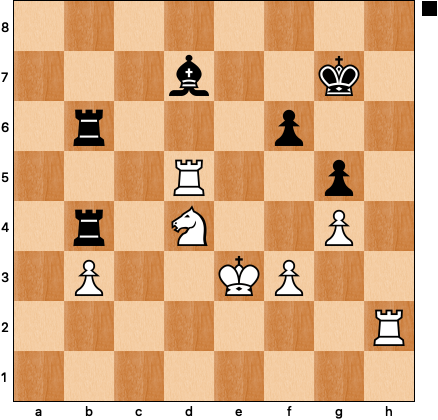
White just captured on d5; for a while now black has been reliant on the idea of 41 … Be6 to win back the pawn on b3. The problem is that after 42 Rd8 black cannot play 42 … Bxb3 because of 43 Nf5+ Kg6 44 Rh6+ Kf7 45 Rh7+ Ke6 46 Re7#. Instead, he had to give an exchange to save himself — 42 … Rxb3+ 43 Nxb3 Rxb3+ 44 Kf2 Rb2+ 45 Kg3 Rxh2 46 Kxh2:
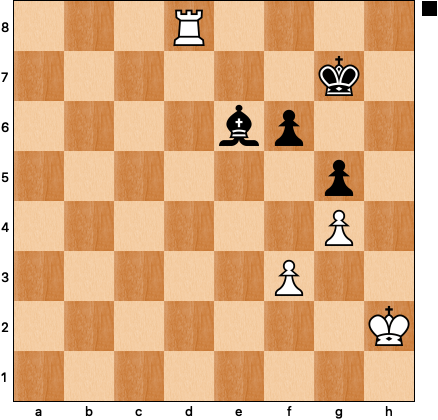
This position is a reminder that it’s important to know the basic fortresses, but it also signals that Sindarov isn’t going to grovel for draws in the second half — he’s going to push hard and when the draws come, they are going to be from a position of strength.
One of the wonderful aspects of watching someone like Sindarov find their peak form is seeing how well they play all kinds of positions. The player becomes Proteus, assuming the shape of the legends of the past. In round one, once he got the advantage, Sindarov’s attack unfolded along both sides of the board in the style of Alekhine. In round three his willingness to sacrifice a piece for sustained pressure reminded me of the wild imagination of Mikhail Tal. By round four he had become Fischer, possessed by a terrifying clarity of purpose as he exploited the weaknesses in Caruana’s position. In round five he was Korchnoi, willing to suffer in exchange for a couple of pawns as he convincingly extinguished Nakamura’s initiative. His victory in round six over Wei Yi was worthy of Carlsen, whose ability to win seemingly innocuous double-king pawn positions from the black side is second to none. And finally, in round seven, he tried to play like Karpov, coming up just short of his fifth consecutive win.
Where does he go from here? Historically speaking, a score between 8.5 and 9.5 has been enough to win the Candidates. Drawing out would put Sindarov at the high end of the winning scores, equal to Nepo’s 9.5/14 from 2022, and a sixth win (without a loss) would set a new record for the event. On the other hand, a mediocre finish (say 2.5 of the final seven) would leave him in range of a motivated and dangerous Caruana.
The prediction markets are bullish about the Sindarov’s chances in the Candidates and the World Championship match to come:
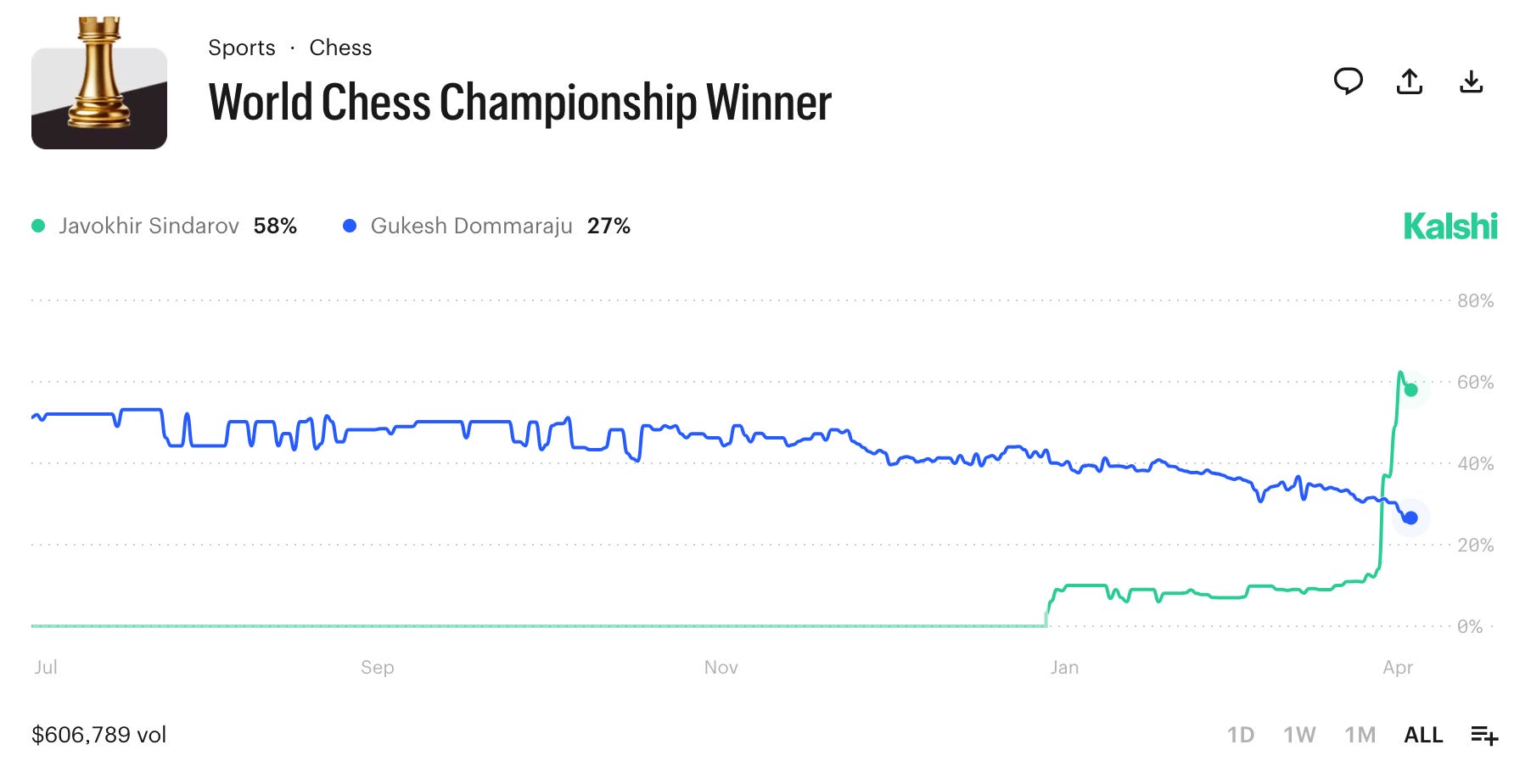
Nothing about Gukesh’s recent performances have inspired confidence, but I personally find it crazy that Sindarov, who hasn’t even won the Candidates yet, is considered twice as likely to be world champ at this time next year. That’s 2024 Ding Liren territory, and even Ding was able to hold his own for most of the match. I also wouldn’t count out Caruana, who is capable of winning a bunch of games in a row and will have white against Sindarov in their critical round eleven game. That’s a must win, and then he’ll have to pick up another point or two along the way — difficult, but not impossible. That said, it’s Sindarov’s tournament to lose, and there’s no reason to think that he’s going to turn into a pumpkin.
As Sindarov’s lead expanded over the past few days, I found myself yearning for the high drama of the 2024 Candidates, where the top four players were separated by a half point and all facing each other in the last round. But the kind of tournament Sindarov is having creates a different sort of drama, the kind that happens when one competitor has left the peloton behind and is racing against their own limitations and those of history. Let’s see what the kid can do.