
Invitation to a Post-Mortem
Alt. title: What Timman Knew, Part Deux.

A week or two ago I wrote the intro to this piece, in which I resolved to take up the challenge of Timman (and before him, Botvinnik), and annotate a game by hand, no matter how many mistakes I made or how foolish I looked when publishing the results of my efforts. Had I realized how many hours of work it would take I might never have suggested such a thing, but having committed myself in writing I felt honor-bound to see it to the end. I’m no Timman, and didn’t have forty hours to burn on a single game, but I learned a lot by doing the work myself and I also threw in a whole lot of “maybes” and “I’m not sures” to indicate that many of the conclusions that I would have liked to draw remained out of reach, particularly in the endgame.
This post is an open invitation to critique my analysis and offer suggestions. I didn’t use an engine, so I’m not interested in engine ideas, but anything human is more than welcome. Thanks for reading, and on to the game.
FM Andy Lee - GM Djurabek Khamrakulov, USAT East 2026, Round 5.
We began 1 e4 Nf6 2 e5 Nd5 3 d4 d6 4 c4 Nb6 5 exd6 cxd6. Just as the bidding that opens a hand of bridge allows the players to communicate information about their cards, the opening of chess game provides information about each player’s intentions. You don’t play the Alekhine Defense if you’re aiming for equality with the black pieces, so my opponent’s decision to unbalance the game further by recapturing with the c-pawn came as no surprise. Fortunately, I still knew a little theory: 6 Nc3 g6 7 Be3 Bg7 8 Rc1 00 9 b3:
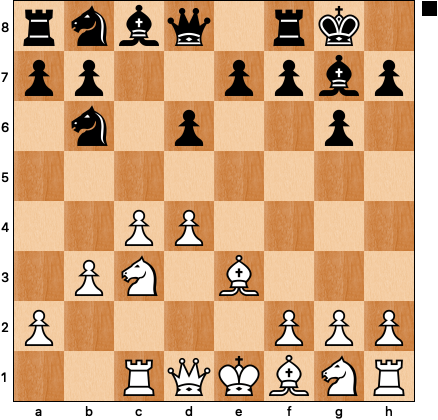
This setup is considered difficult for black. By delaying the development of the kingside pieces white can meet 9 … e5 with 10 dxe5 dxe5 11 Qxd8 Rxd8 12 c5 N6d7 13 Bc4 Nc6 14 Nf3. Black has to play precisely to avoid getting into serious trouble. What alternatives does black have to opening the center? One typical Alekhine plan is to wait for Nf3 in order to play Bg4 and d5, with the plan of rerouting the Nb6 to f5 via c8 and e7, but the semi-waiting moves 9 … Nc6 and 9 … Bf5 both come with their own problems. My opponent found another idea, perhaps more clever than good: 9 … h6.
My experience as a weaker master struggling against grandmasters is that they want you thinking on your own as soon as possible so that you can start making mistakes. I wasn’t sure what to make of this half-push of the h-pawn, but I figured that normal development couldn’t be bad and played 10 Nf3. The blitz part of my brain always wants to respond to P-R3 with P-R41, but here 10 h4 allows black to return to a better version of the main line with 10 … e5 — it’s far more valuable for black to have covered g5 than for white to have a pawn on h4, and in the variation in the previous paragraph black most frequently plays 14 … h6.
The game continued 10 … f5 11 d5, starting to take on the characteristics of the Leningrad Dutch. Pushing the d-pawn is natural; white wants to be able to use the d4-square for a minor piece, but I also wondered if I could play 11 Qd2 instead. The point is that after 11 … Kh7 12 h4 e5 black gets splattered in a thematic way: 13 dxe5 dxe5 14 Qxd8 Rxd8 15 c5 N6d7 16 Bc4 f4 (what else?) 17 Ng5+ hxg5 18 hxg5+ Bh6 19 Rxh6+ Kg7 20 Rd1! fxe3 21 Rd6 — nobody’s protecting the black king. Maybe black is surviving 11 … g5 12 h4 f4 13 hxg5 hxg5 14 Nxg5, but it sure looks terrifying.
Black played 11 … N8d7, and I faced a minor decision that had major ramifications later on: where to develop the king bishop?
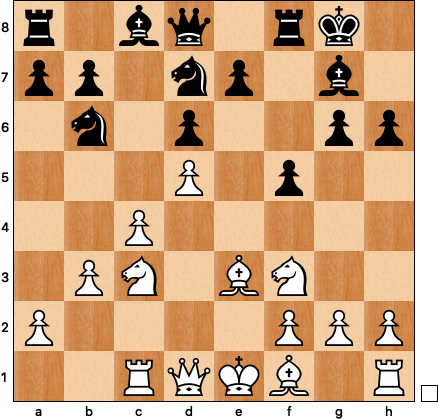
If I had this position again I’d be tempted to play 12 g3, controlling f4 and using the presence of the bishop on the long diagonal to discourage a future e6 or e5 break. 12 Be2 felt passive — I wanted a rook on the e-file and e2 open for the knights — but the move I chose, 12 Bd3, allows black to gain time when he swings his knights to c5 and e5. The b1-h7 diagonal just isn’t as promising as it seemed at the time.
Black completed his kingside expansion with 12 … g5, but it’s hard to suggest another good move, as 12 … Nf6 is met by 13 h3 with Qd2 and g4 to follow: now the Bd3 is going to get into the game! In any event, black wants to get his knight to e5, not f6.
Now I won the f4-square for my knight: 13 h4 g4 14 Nd4 Nc5. 14 … Ne5 allows white a quick regrouping with 15 Nce2, heading to f4, but after the text 15 Nce2 drops material to 15 … f4.2 A maneuvering phase begins: 15 Nde2 Nbd7 16 Nf4 a5:
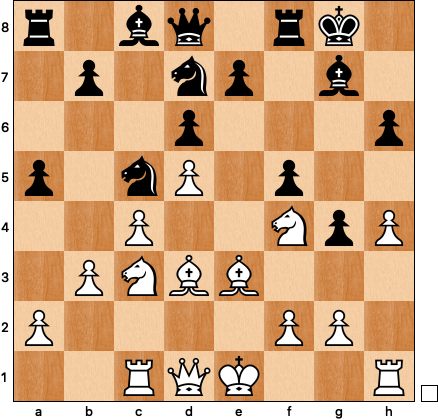
Black had a long think about his previous move, most likely looking for ways to stop 17 Nh5. And I can’t explain why I didn’t just play it! Black can feign counterplay with 17 … Be5 18 Bxh6 Rf7 but there doesn’t seem to be anything there. The alternative is to allow white to take on g7, but once the bishop is gone, black the same old weaknesses but much less counterplay.
I was playing as if I had all the time in the world, which was true — to a point. 17 Nb5 (17 Nce2, heading to g3, is also interesting) 17 … Ne5 18 Be2 (given how the game went, 18 Bb1 would have been preferable, although I’m not sure that this is a mistake on its own) 18 … Bd7 19 Nd4 Qe8 20 Qc2:
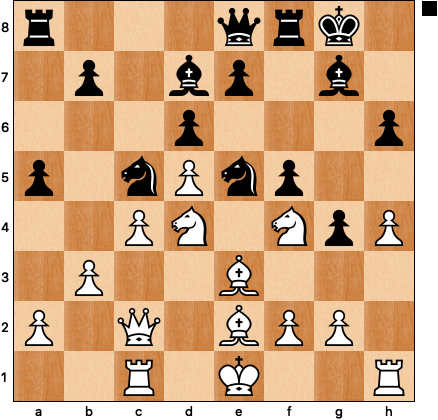
Let’s call white’s move what is was: a bathroom move. Perhaps not in the literal sense of term, the “I’ve-gotta-go-to-the-bathroom-so-I’ll-play-something-fast-that-doesn’t change-the-position-much,” but definitely in the same spirit, given that I’d improved my position as much as I could and didn’t know what to do next. 20 h5 would have better, since now black played 20 … Ng6 and took over the initiative.
With the bishop on e2 the knights are oddly discoordinated. It’s much too late for 21 Nh5 Be5, and 21 Nxg6 Qxg6 22 g3 Be5 also looks unpleasant, as black is going to break with f5-f4 sooner or later. It was time to admit that something had gone wrong, although I’m not sure that 21 Qd2 was the right solution:
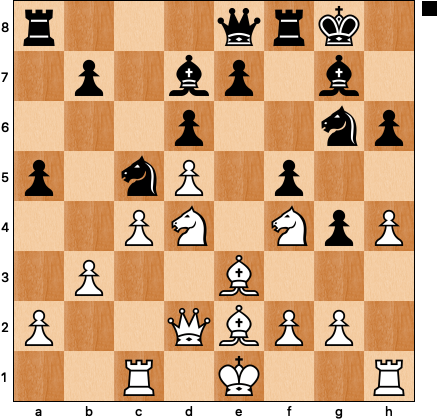
21 … Ne4 is very dangerous. 22 Qd1 is now forced (22 Qd3 g3 23 f3 Nf2 wins; 23 Bh5 is impossible because 23 … Nxf4 hits the white queen), but 22 … Be5 (not 22 … g3 23 Bh5) 23 Nfe6 f4 24 Bd2 g3 is trouble. This leaves white with some less than ideal moves, such as 23 g3 or 23 Nxg6.
Fortunately for me, black played 21 … Be5 and now there’s time for 22 f3, covering e4. There followed 22 … h5 23 Rd1 (an important move, as we’ll see later) 23 … Qf7 24 Nxg6 Qxg6 (24 … Bg3+ 25 Bf2 doesn’t offer much) 25 Bf4 Rae8 (25 … gxf3 26 gxf3 Qg2 27 Rh2 Qg1+ 28 Bf1 is good for white and a first example of the utility of 23 Rd1) 26 00:
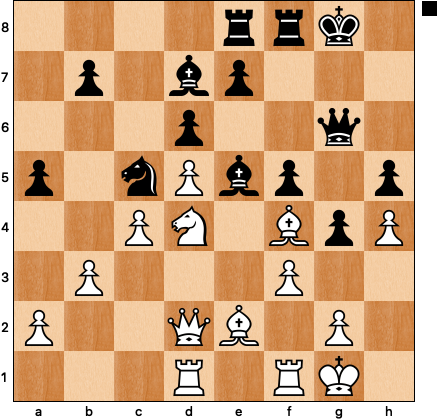
It’s worth noting that the match situation was looking very good: we were winning on boards two and four. I was surprised to see 26 … Bxd4+ appear on the board, but it makes some sense to mix things up and try to win in mutual time trouble, particularly given that one alternative, 26 … Bf6 27 g3 gxf3 28 Bxf3 Bxh4 loses to 29 Qh2, and another, 26 … Qf6 27 Bg5 Qg6 28 Bf4, goes nowhere.
Now everything is forced or nearly forced for the next few moves: 27 Qxd4 e5 28 dxe6 e.p. Nxe6 29 Qxd6 Bc6 (another tactical line saved thanks to 23 Rd1 is 29 … Nxf4 30 Qxf4 Rxe2 31 Rxd7) 30 Bc1 (30 Bg5 is met by 30 … Kh7) 30 … Rd8 31 Qe53 gxf3 32 Rxf3 (32 Bxf3 Bxf3 drops a rook) 32 … Bxf3 33 Bxf3 Rxd1+ 34 Bxd1 Qf6:
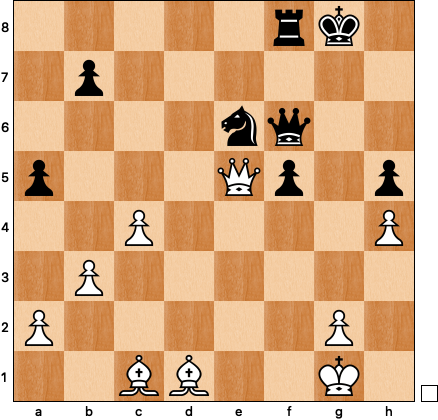
This is a hard position to properly assess with just a couple minutes left on the clock and six moves to go before time control. I badly wanted to keep the queens on; the idea of the queen and bishops raking along the open diagonals was hard to resist. I just didn’t see anything after 35 Qg3+ Kh7 and I still don’t. The match situation meant that I shouldn’t risk losing to play for a win, so 35 Qxf6 Rxf6 36 Bxh5 Nc5 37 Bf3 with some advantage for white:
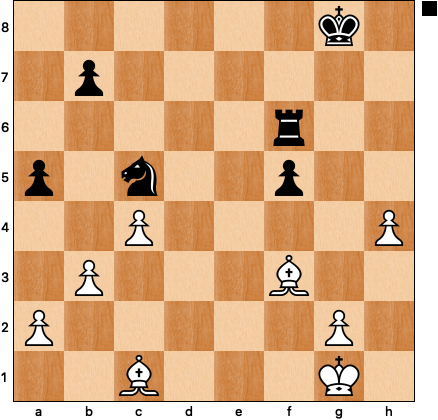
We were still a few moves away from time control, but rather than playing 37 … b6 to create a stable square for the knight, my opponent chose to liquidate the queenside: 37 … a4 38 Bd5+ Kh7 39 Be3 axb3 40 axb3 (not 40 Bxc5 b2 and queens) 40 … Nxb3 41 Bxb7:
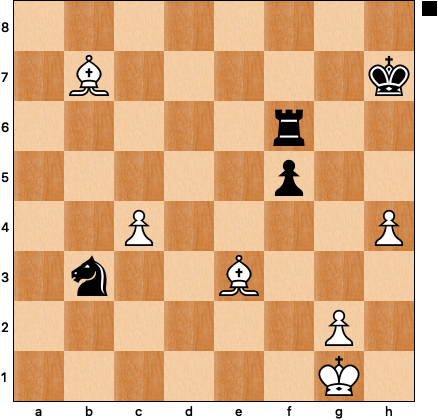
General endgame theory recommends trading pawns when down material, but I think that black’s position is much more difficult than it was four moves ago. Black’s position is close to “zero-gravity”4 in that he has very few pawns left to tether his pieces to. That’s not a problem for the rook, but it’s a real issue for the black knight, which could have been happy for some time on c5. Another problem is that black’s exchanges have left white with a passed c-pawn that is going to be hard to stop; finally, there are fewer white pawns on the board and therefore less counterplay.
I spent a whole lot of time trying to find a reliable drawing line for black without success. My opponent also spent over half of his remaining time5 in this position, so maybe black’s already lost, although I’m not at all confident in that appraisal. In any event, here are some variations:
Counterplay with the f-pawn: 41 … f4 42 Bf2 Nd2 43 c5 f3 44 c6 Rf7 45 Bb6 Ne4 46 gxf3 Nd6 47 c7 Rxc7 48 Bxc7 Nxb7. White is up two pawns and should win.
Blockading on c5: 41 … Rf7 42 Bd5 Rc7 43 Kf2 Nc5 44 Bxc5 Rxc5 45 Ke3 Kg7 46 Kd4 Ra5 47 Ke5 Kg6 48 h5+ Kxh5 49 Kxf5 and black’s king is very far from helping contain the c-pawn.
A trappy mix of both ideas: 41 … f4 42 Bf2 Nd2 43 c5 Rf7 44 Bd5 Rf5 45 Be6 (but not 45 c6 Rxd5 46 c7 Nf3+ and black can stop the c-pawn) 45 … Rf6 46 Bd7 Rf7 47 c6 and wins.
Black’s plan in the game put up more resistance: 41 … Na5 42 Bd5 Nc6. It’s sometimes good (as in variation #2 above) to trade one of the bishops for the knight, but not here — white’s king isn’t close enough to the center, and 43 Bxc6 Rxc6 44 c5 Kg6 45 Kf2 Kh5 46 Kf3 Kxh4 47 Kf4 Rg6 48 Bf2+ Kh5 49 g3 Rf6 50 Ke5 Rf8 51 c6 Kg4 is drawn. I played another bathroom move, although not a bad one, 43 Bg5, assuming that 43 … Rd6 was forced, only to be surprised by 43 … Rg6:
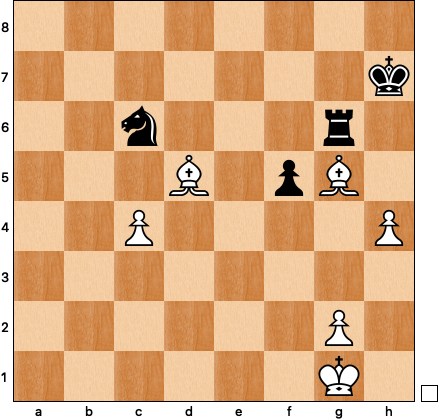
White’s idea is to play 44 g4 to take advantage of the potential pin on the b1-h7 diagonal. This trick is not terribly hard to for black to anticipate, and I suspected a trap. I don’t think white can win against best play: 44 … fxg4 45 Be4 Kg7 46 Bxg6 Kxg6 47 Kf2 Kf5 48 Kg3 (48 Ke3 Ne5 49 c5 g3 50 Bf4 Ng4+ 51 Kf3 g2 =) 48 … Nd4 49 Be3 Ne2+ 50 Kf2 Nc3 51 h5 Ne4+ 52 Kg2 Kf6. The immediate problem is that 53 c5 Nxc5 54 Bxc5 Kg5 is an instant draw, but how else does white make progress?
Shereshevsky reminds us to use the king in the endgame, so 44 Kf2 Nb4 45 Ke3 Ra6 (45 … Nxd5 46 cxd5 Ra6 47 Kf4 Kg6 48 h5+ Kxh5 49 Kxf5 wins) 46 Kd4 (now 46 Kf4 Ra5 causes some problems) 46 … Kg6 47 Bf3 Nc2+ 48 Ke5 Ra5+ 49 Bd5:
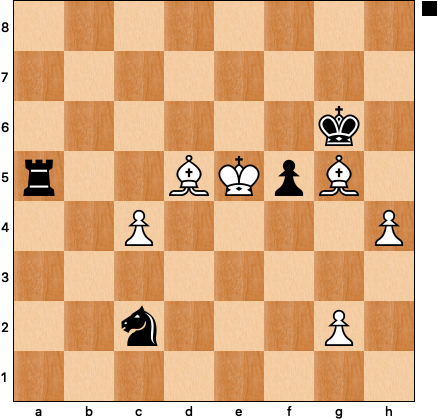
White has made some progress; black’s knight is still floating around aimlessly, a predicament best illustrated by 49 … Ra6 50 g4. It’s hard to find a good suggestion here, but 49 … Nb4 50 Bd2 Nxd5 (at least 50 … Nd3+ 51 Kd4 Ra3 is worth a try) is immediate capitulation. Of course, white must be precise: 51 Bxa5 (not 51 cxd5 Ra2 52 Bg5 Rxg2 and black has just enough counterplay) 51 … Ne3 52 Kd4 (again, not falling for 52 c5 Nc4+ 53 Kd5 Nxa5 54 c6 Nxc6 55 Kxc6 Kh5 56 g3 Kg4, drawn) 52 … Nxg2 53 c5 Kf7 (there simply isn’t time enough for 53 … Nxh4 54 c6 Nf3+ 55 Kd5) 54 c6 Ke6 55 h5 Nf4 56 h6 Ng6 57 Kc5 f4 58 Kb6 f3 59 Be1 Kf7:
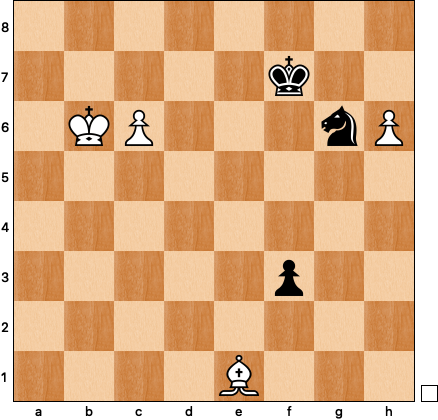
Black switches his king to the h-pawn and knight to the c-pawn, but it isn’t enough. 60 c7 Ne7 61 Kc5 (it’s still possible to blow it: 61 Bf2 Nd5+ 62 Kb7 Nxc7 63 Kxc7 Kg6 64 Be3 f2 with a draw) 61 … Kg6 62 Bf2 Kxh6 63 Kd6, and black resigned in anticipation of 63 … Nc8+ 64 Kd7, and the knight is trapped.6
Phew! It’s hard to beat a GM, and I don’t do it very often. In fact, this is the first time that I’d beaten a GM in a tournament without swindling them from a worse ending, and the nerves involved in trying to finish the game were incredible. I was glad to win it, and very glad to have a second good tournament result in a row. Now I can go back into semi-retirement for a few months and enjoy the upcoming Candidates Tournament as a chess fan and spectator.
Descriptive notation has its problems, but sometimes it’s helpful to have a notation system that can describe a mirror image idea so neatly.
Thanks, in part, to the Bd3 being in the way of white’s coordination on the d-file.
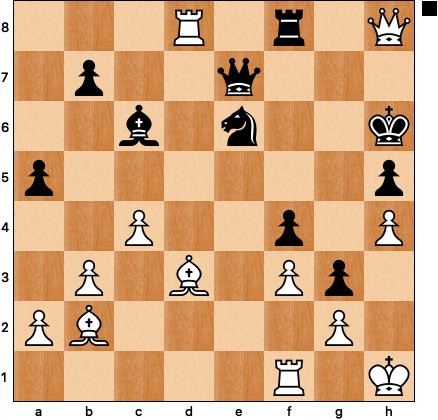
This variation isn’t important enough for anything more than a footnote, but I spent some time looking at 31 Qg3 f4 32 Qe1 g3 (32 … Nd4 wins simply enough) 33 Bb2 Qf5 34 Qc3 Qc5+ 35 Kh1 Kh7 36 Rxd8 Qe7 (now it looks like white is toast, but wait!) 37 Bd3+ Kh6 38 Qh8+ and mates:
A very useful term coined by our second board, Taylor Curtis, way back in 2001.
There aren’t many tournaments these days with a second time control at move forty; almost everyone seems to have gone to G/90 with a 30 second increment. The extra 30 minutes helped a lot in this game, particularly as it gave me a chance to stand up, walk around, and calm my nerves before finishing the game.
Strangely enough, I was on the losing side of an almost identical position against my friend Michael Aigner years and years ago. It was only when I remembered this that I relaxed a bit — ah, he beat me by trapping my knight on c8 back then, so this must be winning the same way.
Nice win and interesting analysis Andy! After 37... a4, my instinct would be to play 38. Bd5+, then 39. b4 keep pawns on the board, and target the b-pawn. Did you look at this? If Nd3 we can play Bd2, or if Na6 we can play a3. Admittedly without deep analysis, but it seems like Black will have trouble keeping the b-pawn.
Glad to have helped calm your nerves, but I frankly don't remember our game.