
On Gumption
Fighting back when your back is against the wall.

It’s been six years, but I’m once again making the trek out the Parsippany, New Jersey this weekend to play in the U.S. Amateur Team East. Team tournaments (in my opinion) are dramatically more fun than playing solo, and the USAT East is the best of the bunch, five to ten times larger than its regional counterparts. My college team won the 2003 team event in Illinois, back when it was still called the USAT Midwest, with an average rating of about 1900, but that kind of Cinderella story isn’t possible in the East. There are simply too many strong teams, too many titled players on the top boards — the only prize we’ve ever won in the East was best team name.1
The whole weekend is a magnificent whirlwind of chess, from the carnival barker spirit of organizer Steven Doyle to the old-school time controls2 to the early morning round on the final day, a game that feels like it’s starting at 6 AM to those of us from the west coast. It’s a great chance to reconnect with old friends — I’m playing with some of my college and high school teammates — and to face a different set of opponents from the usual suspects here in the Bay.
Playing on board one is a particular challenge because you never know when you might sit down across from an IM or GM. Sometimes these guys are headlining the top teams, but they can also be found supporting a trio of lower students, as in “Hey, our opponents this round have an average rating of 1600, but John Fedorowicz is playing board one.”3 I’m not used to playing five or six rounds without winning a game, but that’s what happened on my first trip to the East, and given level of opposition I faced I thought it was a pretty decent performance.
What’s needed is survive on the top board is gumption, defined here by Jonathan Rowson in Chess for Zebras:
Gumption … means resilience, it means not giving up. But it’s more than that too. It means staying interested in the task at hand even when you can’t make the task go the way you want it to. In a chess context, gumption means having the presence of mind and attentiveness to notice important details in the position, long after others have given up and/or agreed a draw. It is not so much the will to win that drives you on, but the will to keep on playing and the will to keep on looking for reasons to keep on playing!
Rowson’s writing about grinding out wins from equal positions, but the same idea applies when fighting for a draw from a bad position. You can give up, either by resigning immediately or by going through the motions and resigning later, or you can stay attentive and fight on. What follows are a few examples of gumption in action.
2014 was my first trip to Parsippany, and though as a team we were playing down in the first round, I was playing up against IM Mikhail Zlotnikov on board one. I tried to play a Hedgehog setup, blundered away a pawn, and was lucky to get to an opposite colored bishop ending:
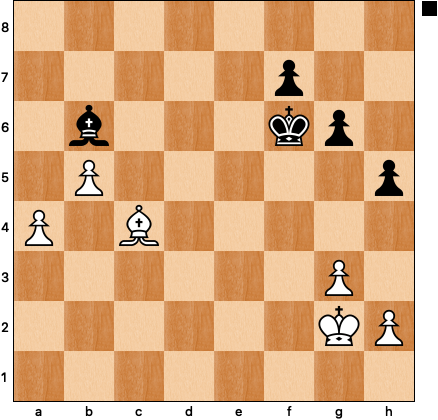
Should black be playing for counterplay with his extra pawn on the kingside? No, he should not. The only path to the draw is to remove the kingside pawns as light-squared targets, starting with 69 … g5! After 70 Kf3 I should have kept to the plan with 70 … h4!, but erred with 70 … Ke5? White’s 71 Bxf7? returned the favor — 71 h4!, fixing the h-pawn on a light square, would have won — and I didn’t need a third chance to find the right defensive idea: 71 … h4! 72 Kg4 hxg3 73 hxg3 Kf6 74 Bb3 Ba5 75 Kf3 Ke5 76 Ke3:
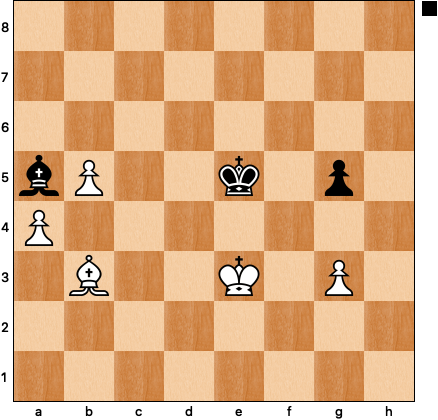
Black does not miss the f-pawn; what’s important here is that black’s king can follow white’s to the queenside to maintain the blockade while the remaining black pawn is safe on g5. There’s no second weakness for white to exploit, and he offered a draw four moves later.
In round five4 I had the black pieces against GM Alexander Onischuk and was suffering in an even worse pawn-down endgame:
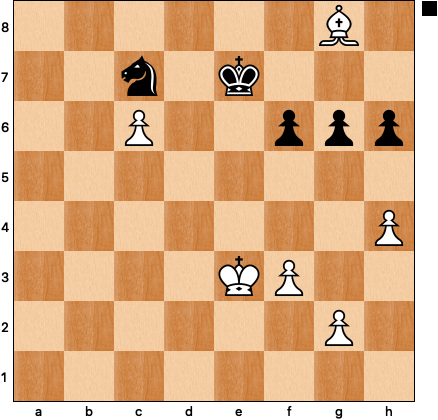
The theory of two weaknesses is all too relevant this time. On the one hand, white is going to soften up the g-pawn with h4-h5 and then invade on the light squares: Ke3-e4-f5-g6. On the other hand, black has to devote some of his few remaining resources to the far advanced c-pawn. Fortunately I noticed a small but critical detail that my opponent had missed5: 42 … Kd6 43 h5 Kxc6! It feels strange to allow a new passed pawn to appear on g6, but the knight can be good at holding a fortress if it’s on the right track — and it just so happens that it is. After 44 hxg6 Ne8 45 Ke4 Ng7 there is no way in for the white king, and the g-pawn is stuck in its tracks:
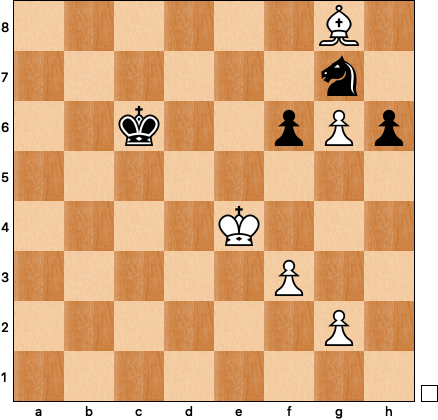
We played on for a dozen more moves to confirm that there is no zugzwang, but the black knight always has access to either e8 or h5 (thanks to the h6-h5 break if white pushes g2-g4).
My favorite save comes from this game, played at the USAT East three years later, against GM Alex Fishbein:
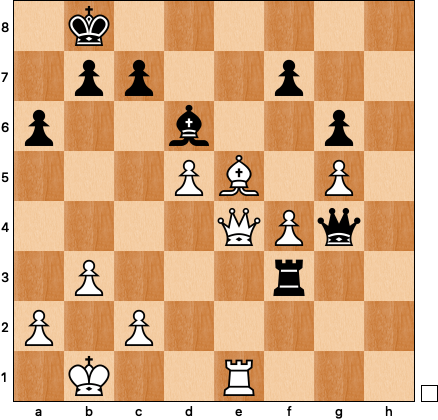
I’d come close to beating Fishbein the previous year, only to run into a string of gumption-induced moves that left me with a meaningless extra pawn in a drawn rook and pawn ending. This time around I was the one in a desperate situation, down a pawn and with no obvious targets for counterplay. I’d just played Rh3-f3, one last trap, and was pleasantly surprised to see the line I’d calculated appear on the board: 31 Bxd6? (31 Qd4! keeps the pressure on, but it’s hard to resist the temptation to win a second pawn) 31 … cxd6 32 Qe8+ Ka7 33 Qxf7 Rxf4 34 Qxg6:
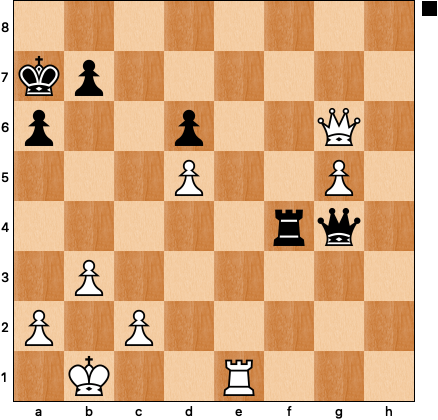
White’s position feels like it should be winning: up two pawns, the d6-pawn under attack, the black pieces oddly placed (doing what exactly?) on the fourth rank. Despite all this black’s position is not hopeless: 34 … Qg3! 35 Qe6 (the white rook can’t leave the back rank because of Qg1+ and Qd4+) 35 … Rg4 36 Qe3+ Qxe3 37 Rxe3 Rxg5 38 c4 b5:
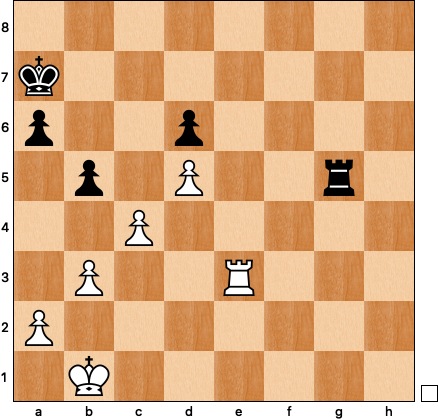
It’s a liquidation sale — first the bishops, then the kingside pawns, then the queens — and suddenly black has found the safe harbor of the four v. three rook and pawn ending. True, the fellow on d6 is a little weak, and had Fishbein played 39 Kb2 I would have had to be careful, but after 39 cxb5 axb5 40 Rd3 there was little left to play for.
Gumption requires the desire to keep fighting and the energy to keep playing good moves from a bad position. Sometimes you have it and sometimes you don’t, but team tournaments tend to bring out inner fighter the inner fighter in me. I like to win matches, I hate letting my teammates down, and, in the occasional matches where we get blown out, I think that 0.5-3.5 or 1-3 looks a lot better than 0-4. Without gumption, most bad positions are resignable, with it all kinds of strange miracles are possible.
“Legalize Caruana”, right around the time Fabi was switching from the Italian Federation to the US.
Time added after move forty! Next thing you know they’ll bust out the sealed move envelops.
This happened in 2018, right after future-GM Brandon Jacobson had kicked my butt.
That’s the great round of sleepiness that starts at 9 AM Eastern, 6 AM Pacific.
White’s last move before the diagrammed position was h2-h4, which seems to throw away the win. Ke3-e4 instead would have won.
Yes, gumption is needed, but so is limitless energy. (BTW I won't be making it to USATE after all, unfortunately.) Good luck and safe travels Andy!
I like Rowson's definition of "gumption" in 7DCS (the antidote to Wanting) as some combination of enthusiasm, composure, and practicality:
"Something like 'psychic gasoline' which will fuel you throughout the ups and downs of the forthcoming challenge."